Rifle Scopes

Air rifle scopes have to focus close, survive a springer’s double recoil and stay honest under a slow, arcing pellet. This category lists 30+ day optics from Element Optics, Vector Optics, Arken Optics, Vortex and Victoptics. Night vision, thermal and red dots sit in their own categories, and mounts and rails are listed separately.

Showing 1–24 of 40 results

Filter

What makes an air rifle scope different from a centrefire scope?

Two things: which way the rifle recoils, and how close the scope can focus. Neither is marketing, and both cost money to get wrong.

A springer recoils twice, and the second one kills scopes

A spring-piston rifle recoils backwards, then forwards again when the piston slams into the end of the compression tube. That second impulse shears reticles loose and walks erector tubes out of position. A scope built for one rearward pulse often does not survive it, and airgun forums have been logging this failure mode for twenty years.

Raw recoil energy is not the problem. A centrefire rifle pushes harder in one direction and leaves scopes alone; the reversal is what does the damage. Gas ram rifles are no exception, because the piston still stops dead against the end of the tube.

Parallax has to wind down far closer than 100 m

Plenty of centrefire scopes are parallax-corrected at a fixed 100 m (109 yards) and will not focus below 45 m. Airgun work starts at 10 m and rarely passes 100 m.

Set the parallax to 25 m with the target at 10 m, drop the magnification and move your head slightly: the crosshair swims across the target. That is a point-of-impact problem, not a clarity problem, and it is the spec most people check last. It also gets worse at low power on a high-magnification scope, which is the opposite of what most shooters expect.

What magnification do you actually need?

For mixed work, 3-12x or 4-16x. Higher costs you more than it buys.

The magnification filter on this page runs from a fixed 1x up to 7-35x. A pellet at 16 joule (12 ft.lbs) starts dropping hard past 30 m, so beyond a point you spend your time reading holdover rather than resolving detail. Above roughly 12x the eyebox tightens until your own pulse shows up in the sight picture.

The counter-argument is target size. A 25 mm kill zone at 45 m (49 yards) is genuinely small, which is why airgunners run more magnification than their distances suggest. Four of the scopes here are 4-16x and six are 6-24x, which is roughly where slug shooters and 100 m pellet work sit. Three fixed 10x scopes and a 14x cover shooters who set a power once and leave it there.

Two things the magnification number does not tell you

  • Depth of field shrinks as power climbs. A big objective at 24x gives you a knife-edge slice of focus and nothing either side of it, which is precisely wrong for hunter field target.
  • Holdover is only as good as your velocity data. Put a chronograph behind the muzzle and feed the app your own numbers rather than the box figure.

Power limits differ per country, 7,5 joule in Germany and 16 joule (12 ft.lbs) in the UK among them, so check what applies where you shoot before you plan a trajectory.

FFP or SFP: which reticle plane fits your shooting?

Of the 39 scopes listed, 21 are FFP and 17 are SFP. The deciding question is whether you change magnification mid-session.

FFP: the reticle scales with the power

In first focal plane the reticle grows and shrinks with the magnification, so mildot spacing stays true at any power. That is what you want when you dial power up and down through a session and hold over with the reticle instead of the turrets. The cost is a reticle that goes thin at 4x against a hedge and thick at 24x over a 10 mm dot, and the wider the zoom ratio, the harder that compromise bites.

SFP: the reticle stays the same size

Subtensions are only correct at one stated magnification, which sounds like a limitation until you meet a field target shooter who has not touched the power ring in three seasons. SFP also stays visible at low power, which is why compact SFP scopes remain popular on springers with a loading port to clear.

Illumination softens the same problem from the other side: 26 of the scopes here have it, 11 do not, and it earns its place at dawn and dusk far more than in daylight. One note either way, high magnification punishes a dirty objective, and a smeared lens costs more contrast than the glass grade ever will, so keep an optics cleaner in the case rather than a shirt sleeve.

Shooting jobMagnificationReticle positionTube diameterTurret adjustmentIllumination
Close pesting and plinking, 10-25 m (11-27 yd)2-8x, 3-9x, 2-10xSFP25,4 (1″) or 301/4 M.O.A.No
Mixed hunting and HFT, 15-45 m (16-49 yd)3-12x, 4-16xSFP or FFP300,1 MradYes
Field target and benchrest, known distance10x, 14x, 10-40xSFP301/8 MOANo
Long-range pellet and slug, 50-100 m (55-109 yd)5-25x, 6-24x, 7-35xFFP340,1 Mrad or 1/10 MILYes

How do you zero an air rifle scope?

Shoot groups, never single shots, and set the parallax to the distance you are zeroing at.

  1. Mount the scope and torque the rings to the maker’s figure, then bore sight roughly before you fire anything.
  2. Set the parallax to your zero distance and keep the same cheek weld every shot. A wandering head position looks exactly like a scope that will not hold.
  3. Shoot a group and adjust from the centre of it. One flyer tells you nothing about where the rifle is pointing.
  4. Recheck after roughly a hundred shots; mounts settle. If a group opens up out of nowhere, check the rings and the stock screws before you blame the glass.

What one click actually moves

The turret filter tells you what you are buying: 0,1 Mrad moves the group 5 mm at 50 m (0.2 in at 55 yards), while 1/4 M.O.A. moves it about 3,6 mm at the same distance. Fifteen of the scopes here click in 0,1 Mrad, ten in 1/4 M.O.A., and seven are marked with both.

Mixing units is where zeroing goes wrong. If your reticle is Mrad and your turrets are MOA, every correction needs mental arithmetic under a rifle, and sooner or later you will get it backwards. Match the reticle to the turrets and the job becomes counting.

Zero distance and holdover

Most PCP shooters zero somewhere between 30 m and 50 m and hold over from there, which only works if the range is real rather than estimated. A pellet that is 20 mm high at 30 m can be 60 mm low at 55 m, and guessing the difference costs more accuracy than any scope upgrade returns, so a laser range finder earns its keep faster than more magnification does.

Which scope actually suits your rifle?

Focus distance and reticle plane decide it. Everything after that is fit.

Size and weight are not a detail

The scopes here run from 52 to 1190 gram and 135 to 406 mm. A 406 mm tube over a side-lever loading port is a daily annoyance no amount of glass quality fixes, and nearly 1,2 kg of scope on a lightweight sporter changes how the rifle hangs off a bipod and how it sits in a hunting hand.

Tube diameter decides the hardware, not the brightness

Brightness comes from the exit pupil. A bigger tube buys thicker walls and more internal elevation, which is what you want if you dial to 100 m rather than hold. Of these scopes, 21 are 30 mm, 11 are 34 mm and 3 are 25,4 mm (1″), so check the scope mounts you already own before you order.

If your receiver has an 11 mm dovetail while the rings you want are Picatinny, you need a scope rail rather than a compromise. On a magnum springer, a one-piece mount with a recoil stop pin is the difference between a zero that holds and one that walks backwards a millimetre a tin.

Two rifles, two answers

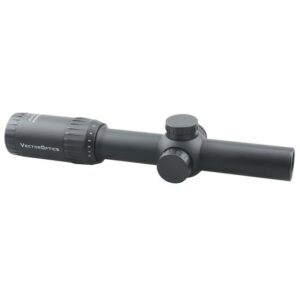
If most of your shooting sits between 10 m and 35 m and the rifle has a loading port to reach past, a short SFP scope is the right tool, and the Vector Optics Veyron 2-8x32IR SFP MPR-V5 Compact Scope Rifle Scope (SCOC-43) is the shortest route to it.

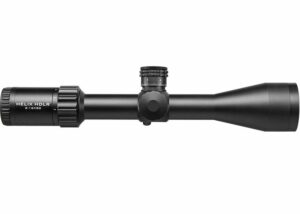
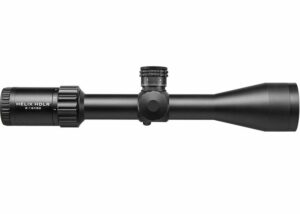
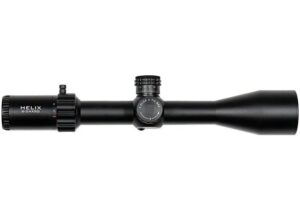
If you shoot slugs out to 100 m and dial rather than hold, go FFP on a 30 mm tube with Mrad turrets. The Element Optics Helix GENII 6-24×50 Riflescope covers that job without the length and weight penalty of a 56 mm objective.

Review counts sit under each product in the grid rather than in a marketing claim, so you can see what has actually been shot: the Vector Optics Veyron 3-12×44 FFP Rifle Scope (SCFF-21) carries three, the Victoptics Cerato 3-9×32 SFP (SCOC-30) five. Across the shop we run 9.9/10 on more than 5,000 reviews. If the spec sheet does not answer your question, get in touch by e-mail or WhatsApp and you get an answer from someone who shoots.

Frequently asked questions about air rifle scopes

What is the best magnification for an air rifle scope?

For mixed airgun work, 3-12x or 4-16x covers almost everything. It gives you a usable field of view at 10 m and enough detail for a small target at 45 m (49 yards). Go higher only if you shoot known distances from a rest, since the eyebox tightens and every wobble is magnified along with the target. Six of the 39 scopes here are 6-24x.

Can I use a normal rifle scope on an air rifle?

On a PCP, usually yes, provided the parallax focuses down far enough. On a spring-piston rifle, be careful. The piston creates a forward recoil impulse on top of the rearward one, and scopes designed for a single pulse can shed reticles or lose zero permanently. Check the maker’s springer rating rather than assuming a tough centrefire scope will cope.

Does the minimum parallax distance matter on an air rifle scope?

Yes, more than most spec sheets suggest. If the target sits well inside the parallax setting, the crosshair shifts against the target as your head moves, even when the picture looks sharp. Airgunners who pest at 10-15 m consistently insist on scopes that focus that low. If everything you shoot is past 30 m, it matters far less.

Which scope suits a break barrel or springer?

A springer-rated scope, a one-piece mount or rings with a recoil stop pin, and preferably a compact body that clears the loading port on a fixed-barrel rifle. Compact SFP scopes in the 2-8x to 4-16x range are the common choice. Length matters here: the shortest scopes in this category are 135 mm, the longest 406 mm.